

What causes vaccination failure and which new therapies are possible?

What is this research project about?

A vaccination is the best protection against hepatitis B. © Deutsche Leberstiftung

What is this research project about?

Hepatitis B Virus (HBV) infection often causes chronic infection, which may lead to liver cirrhosis that can progress to hepatocellular carcinoma. HBV vaccines are considered highly efficacious and are successfully applied worldwide. However, approximately 5% of HBV vaccinated individuals do not mount protective antibody responses after vaccination (non-responders). Previous studies revealed reduced responsiveness to influenza virus vaccination in the elderly. In contrast, HBV vaccination non-responsiveness cannot be explained by increasing age as also young adults are affected. Consequently, factors causing non-responsiveness are largely unclear.

What’s the current status?

It has been observed that non-responders mostly show an overall normal immunoexcitability and normal responses against many other vaccines. So far, only few molecular parameters have been identified that may play a role in conferring the non-responder status. Different genetic components of the innate and adaptive immune system were discussed to be associated with the phenomenon. Multiple Genome Wide Association Studies (GWAS) claimed that certain genetic factors predispose individuals to HBV vaccination failure. The conclusions of the previous studies range from antigen presentation defects to absence of certain antigen-specific T cells. However, a comprehensive model explaining the phenomenon of HBV vaccination non-responsiveness and biomarkers that allow identification of potential non-responders has not been formulated. Accordingly, no vaccination regimen has been developed that would allow successful vaccination of non-responders. This creates challenges particularly for health care workers who are in frequent contact with patients and therefore are recommended to be vaccinated against HBV. Additionally, it is not clear whether those relatively few individuals who develop chronic infection after HBV exposure during adulthood are also HBV vaccination non-responders.
Even though virus propagation can be inhibited by antiviral therapy, HBV infection cannot be eliminated from chronically infected patients.
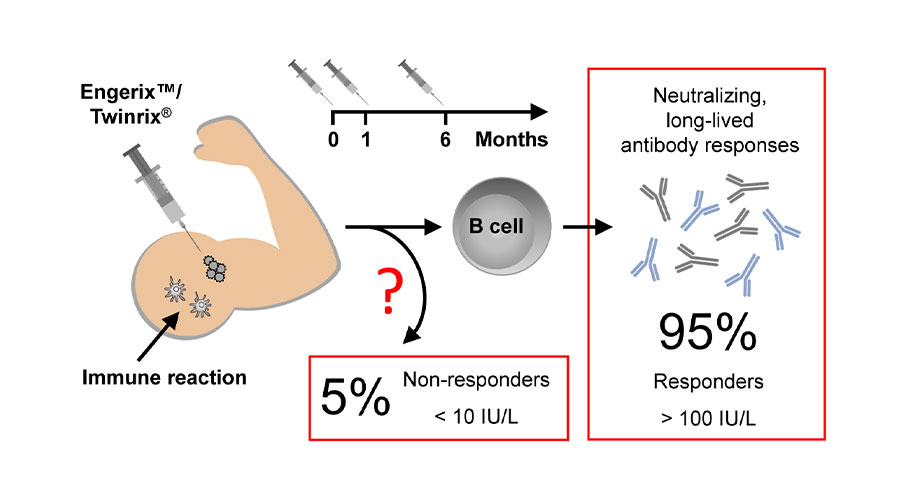
In 5% of the vaccinated persons no protective antibodies are formed, they are called “non-responders”.

What are the project goals?

Currently, we are building up a HBV vaccination non-responder cohort. This cohort will be the basis for studying causes of non-responsiveness in single individuals. This will be performed by deep immunoprofiling of peripheral immune cells at different time points after HBV vaccination as well as whole genome sequencing. Furthermore, cytokine responses induced upon in vitro stimulation of PBMCs from responders and non-responders will be analyzed.
The objective is to generate a comprehensive model of HBV vaccination non-responsiveness. Based on this knowledge, improved vaccination schemes for HBV vaccination non-responders as well as innovative vaccination strategies will be developed.

To this end, new HBV vaccines will be tested in preclinical assays. Additionally, besides determining genes responsible for non-responsiveness, we strive towards a better understanding of how protective immunity against HBV is induced. In particular, we will address whether the HBV vaccination non-responder status favors for the development of chronic HBV infection. Such information could be crucial for developing better treatment strategies of chronically infected people and might open new doors for the concerned patients and doctors. An improved understanding of HBV-induced immune responses has implications on the Stop-NA study.

How do we get there?

Together with the Occupational Health Physicians of the MHH, we are building up cohorts of HBV vaccination responders and non-responders, which constitute an essential element for research towards the molecular basis of HBV non-responsiveness. Currently, first immunomonitoring studies in HBV vaccinated responders and non-responders are being carried out. Additionally, whole genome sequencing and HLA-typing is being performed to identify genetic characteristics associated with non-responsiveness.

Company doctors at the MHH are working on this RESISIST project.


Projectleaders

Project title: Non-responsiveness to hepatitis B virus (HBV) vaccination

Prof. Dr. Ulrich Kalinke

Projects: A4, B9

Prof. Dr. Markus Cornberg

Projects: B8, B9, B10

Prof. Dr. Immo Prinz

Projects: B5, B8, B9

Prof. Dr. Reinhold Förster

Projects: B5, B9, C2

Prof. Dr. Luka Čičin-Šain

Projects: B6, B9, RESIST-Cohort

Publications 2022

Impact of HBsAg and HBcrAg levels on phenotype and function of HBV-specific T cells in patients with chronic hepatitis B virus infection. Aliabadi E, Urbanek-Quaing M, Maasoumy B, Bremer B, Grasshoff M, Li Y, Niehaus CE, Wedemeyer H, Kraft ARM, Cornberg M. Gut. 2022 Nov;71(11):2300-2312. Epub 2021 Oct 26.

Publications 2021

The impact of hepatitis B surface antigen on natural killer cells in patients with chronic hepatitis B infection.
Du Y, Anastasiou OE, Strunz B, Scheuten J, Bremer B, Kraft A, Kleinsimglinhaus K, Todt D, Broering R, Hardtke-Wolenski M, Wu J, Yang D, Dittmer U, Lu M, Cornberg M, Björkström NK, Khera T, Wedemeyer H. Liver Int. 2021 Apr 1. doi: 10.1111/liv.14885. Online ahead of print. PMID: 33794040

Publications 2020

Efficient homing of T cells via afferent lymphatics requires mechanical arrest and integrin-supported chemokine guidance. Martens R, Permanyer M, Werth K, Yu K, Braun A, Halle O, Halle S, Patzer GE, Bošnjak B, Kiefer F, Janssen A, Friedrichsen M, Poetzsch J, Kohli K, Lueder Y, Gutierrez Jauregui R, Eckert N, Worbs T, Galla M, Förster R. Nat Commun. 2020 Feb 28;11(1):1114. doi: 10.1038/s41467-020-14921-w. PMID: 32111837; PMCID: PMC7048855.

Selective reconstitution of IFN‑γ gene function in Ncr1+ NK cells is sufficient to control systemic vaccinia virus infection. Borst K, Flindt S, Blank P, Larsen PK, Chhatbar C, Skerra J, Spanier J, Hirche C, König M, Alanentalo T, Hafner M, Waibler Z, Pfeffer K, Sexl V, Sutter G, Müller W, Graalmann T, Kalinke U. PLoS Pathog. 2020 Feb 5;16(2):e1008279. doi: 10.1371/journal.ppat.1008279. PMID: 32023327; PMCID: PMC7028289. B9

Publications 2019

Update of the statements on biology and clinical impact of occult hepatitis B virus infection G. Raimondo, S. Locarnini, T. Pollicino, M. Levrero, F. Zoulim and A. S. Lok Journal of Hepatology 2019 Vol. 71 Issue 2 Pages 397-408 DOI: 10.1016/j.jhep.2019.03.034

STING induces early IFN-β in the liver and constrains myeloid cell-mediated dissemination of murine cytomegalovirus. Tegtmeyer PK, Spanier J, Borst K, Becker J, Riedl A, Hirche C, Ghita L, Skerra J, Baumann K, Lienenklaus S, Doering M, Ruzsics Z, Kalinke U. Nat Commun. 2019 Jun 27;10(1):2830.

Preferential uptake of chitosan-coated PLGA nanoparticles by primary human antigen presenting cells. Durán V, Yasar H, Becker J, Thiyagarajan D, Loretz B, Kalinke U, Lehr CM. Nanomedicine. 2019 Oct;21:102073. Epub 2019 Jul 31.

RNA-Based Adjuvants: Immunoenhancing Effect on Antiviral Vaccines and Regulatory Considerations. Ziegler A, Hinz T, Kalinke U. Crit Rev Immunol. 2019;39(1):1-14.

Publications of the Project B9