



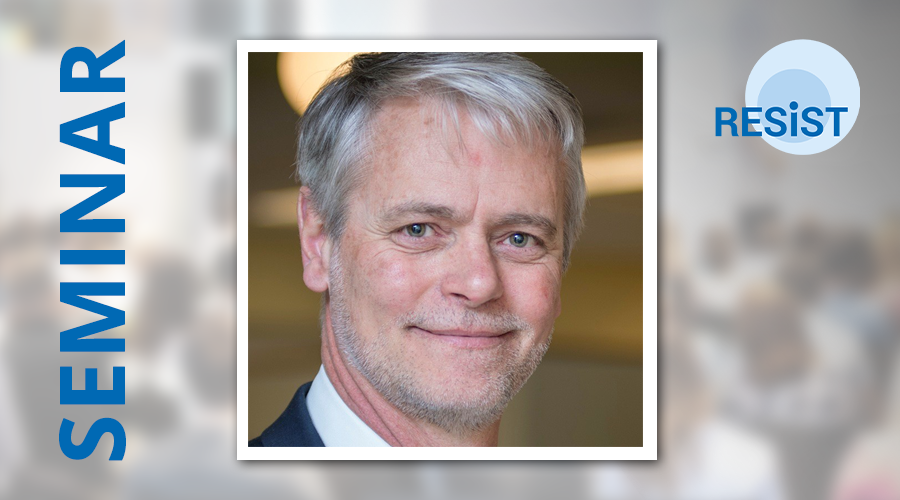
Exciting topics, interestingly presented: Every Thursday, RESIST scientists or top-class researchers from external institutions present their topics at the RESIST seminar series.
Attend these exciting seminars of the Cluster of Excellence RESIST, as a member of RESIST or as a colleague or student.
On 7 May 2026 at 1 p.m., Luis Schang, MV, PhD, Professor of Chemical Virology, Department of Microbiology & Immunology, Baker Institute for Animal Health, Cornell University, will give a lecture with the title “HSV-1 and HSV-2 silencing during establishment of latency in human sensory neurons: implications for pathogenesis and therapy”.
Despite the effective clinical antivirals approved since the 1980’s, herpes simplex virus 1 and 2 (HSV-1, -2) continue to pose major and chronic challenges to human health and well-being. Neonatal infections are life-threatening, ocular infections are the most prevalent infectious cause of corneal transplants in the Western world, herpes encephalitis is lethal or result in serious sequelae, and genital herpes increases the risk of HIV infection, among many other health problems. Herpes simplex viruses are also the cause of major mental health distress and may be involved in Alzheimer’s and other neurodegenerative diseases.
The ability of HSV-1 and 2 to establish life-long latent infections in sensory ganglia is the main barrier to effective management because latent virus does not express viral proteins, which are the targets of most antivirals and vaccines. Latency is challenging to study, too. We have developed a new model of latency in human sensory DRG and TG-like neurons and wild-type strains or clinical isolates of HSV-1 and -2. Latency is established with no antivirals, antibodies, cytokines, or viral mutants and a low multiplicity, reflecting the natural human infection. Using this model, we will show that HSV-1 and -2 lytic genes are expressed during the acute neuronal infection, viral genomes replicate and PML bodies are destroyed, while the infection spreads for about 15-23 days before production of infectious virus ceases. Yet, infected neurons survive, PMLs reassemble around compacted genomes, and the viral genomes persist indefinitely into latency. Viral genomes have positioned nucleosomes on day 7, but nucleosome occupancy and positioning increased in latency. Four nucleosomes were positioned at and around an origin of DNA replication in latency but not during the acute infection. Reactivation up to 56 days after infection induces gene expression, DNA replication and production of cell-free infectious virus with genomes replicated during the acute infection. Abortive reactivations may occur periodically in exceedingly rare neurons.
Together with the number of latent genomes per neuron in cadaveric human samples and latently infected mice, and the activation of lytic promoters in mice before the establishment of latency, these results challenge the conclusion that latency is established exclusively by unreplicated viral genomes with no previous lytic gene expression. These findings impact our understanding of the establishment of latency by herpes simplex viruses and the development of new antivirals acting on the critical stages of latency.
The lecture will take place in Lecture Hall Q, Building J06 of the Hannover Medical School.
If you are interested in participating via video (online), please contact RESIST@mh-hannover.de.
Do you have any questions or suggestions about the RESIST seminar series? Then please contact us.