
Bettina

About Bettina

This author has not yet filled in any details.
So far Bettina has created 465 blog entries.

RESIST researchers help shape patient university

Starting on 3 May, the MHH Patient University will provide interesting information on "Infections" in online lectures at 6 p.m. (in german language) - and RESIST researchers will be there: On 24 May, the lecture by Prof. Dr. Torsten Witte, MHH Clinic for Rheumatology and Immunology, will focus on "Infektionen und rheumatische Erkrankungen" ("Infections and rheumatic diseases"). On 14 June, Prof. Dr. Ulrich Kalinke from the Institute for Experimental Infection Research at TWINCORE will talk about "Geimpft und trotzdem Omikron: Hat die Impfung versagt?" ("Vaccinated but still omicron: Has vaccination failed?") On 21 June, Prof. Dr. Burkhard Tümmler, MHH Clinic for Paediatric [...]
2022-05-12T11:00:51+02:00 2. May 2022|

New RESIST member: Dr. Sogkas

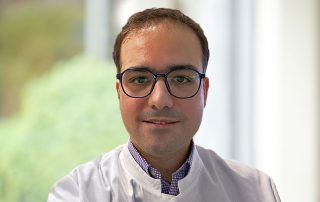
We welcome Dr Georgios Sogkas as a new member of RESIST. The rheumatologist from the MHH Department of Rheumatology and Immunology is now working in the teams of the RESIST projects A2 and B2. The first project revolves around congenital immunodeficiencies and in particular the question how can diagnosis be improved to achieve early identification of as many affected individuals as possible? The second project is looking into the extent to which intestinal bacteria can trigger rheumatological diseases. Dr Sogkas studied medicine at the University of Thessaly, Greece, and then completed his Master's degree in "Integrated Immunology" at the University [...]

2022-12-01T11:53:49+01:00 17. April 2022|

New RESIST member: Prof. Hirsch

We are very pleased to welcome Prof. Dr. Anna K. H. Hirsch, Head of the Department "Drug Design and Optimisation" at the Helmholtz Institute for Pharmaceutical Research Saarland (HIPS) in Saarbrücken, as a new RESIST member. She is now part of the leadership team of RESIST project D1, which aims to find substances that can inhibit the replication and survival of herpes viruses in the body. Within the framework of RESIST, Prof. Hirsch is concentrating in particular on active substances that can inhibit the so-called accessory DNA polymerase protein. This is involved in the multiplication of the Kaposi's sarcoma-associated herpes [...]

2022-05-12T11:01:08+02:00 15. April 2022|

The new RESIST newsletter is here

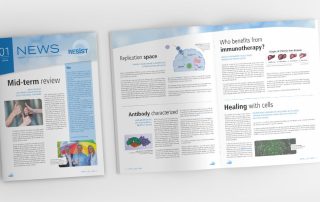
We are pleased to present the new RESIST-newsletter to you here. In it you can read, for example, about the praise RESIST received at the halfway point of the first funding period, about research (p. 6 to 8), the Master's programme in Biomedical Data Science and about HAGIS (p. 10). We hope you enjoy reading it. Your RESIST Newsletter editorial team

2022-05-12T11:01:16+02:00 13. April 2022|

The first student is researching within the framework of HAGIS 

Here we go: On 20 April 2022, the first doctoral student will travel to Glasgow for two months as part of the "Hannover-Glasgow Infection Strategy" (HAGIS). Franziska Hüsers from the research group of Prof. Dr Beate Sodeik from the MHH Institute of Virology will learn a method there in the team of Dr Chris Boutell at the "MRC-University of Glasgow Centre for Virus Research" (CVR), which she needs for her doctoral thesis. So far, Franziska Hüsers only knows Scotland as a holidaymaker, but she has already gained experience abroad during a four-month internship in London. "I like the international atmosphere, [...]

2022-05-12T11:01:24+02:00 7. April 2022|

Replication space

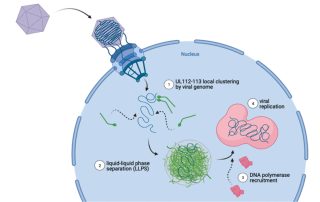
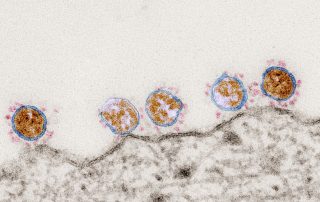
Research team further elucidates how cytomegalovirus replicates: Human cytomegalovirus (HCMV) is a major cause of illness and mortality in immunocompromised transplant patients and the most common cause of infection in newborns worldwide. In HCMV infection, the virus replicates its DNA genome in specialised replication compartments in the nucleus of the host cell. These membraneless organelles arise as round structures and increase in size over time. However, the exact mechanism of biogenesis of the replication compartments is still unknown. A team led by Professor Dr. Wolfram Brune (HPI) and RESIST Professor Dr. Jens Bosse (MHH, CSSB, HPI), has now been able [...]

2022-05-12T11:01:32+02:00 6. April 2022|

Applications welcome: Master’s programme in Biomedical Data Science

Passed the acid test: One semester of biomedical data science completed Very good. That's how Marie Mikuteit, Adrian Schulz and Julia Winkler liked the first semester of the Master's programme in Biomedical Data Science – both the content and the manner. Together with their fellow students, they were able to delve into topics such as 'Introduction to Data Science', 'Basics of Informatics' and 'Clinical Studies and Biobanking', for example. "The course is well structured and has many practical examples," reports Julia Winkler. What was new for many was the way of studying. Because instead of lessons on site, daily laboratory [...]

2022-05-16T09:12:04+02:00 4. April 2022|

How does an intestinal germ become a pathogen?

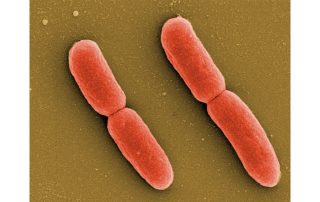
Scientists are looking for a connection between bacterial genes and disease severity The bacterium Escherichia coli is found in the human intestine, and elsewhere. There it is harmless, but in certain conditions it can become a pathogen. It can cause bladder infections or even sepsis. A team of researchers led by RESIST professor Marco Galardini at TWINCORE, together with colleagues from the medical faculty of the University of Paris, has now investigated whether certain genes of the bacterium are associated with the severity of the diseases caused. They have now published their findings in the journal PLOS Genetics. Escherichia coli, [...]

2022-05-12T11:01:54+02:00 4. April 2022|

Research on COVID-19

What works against SARS-CoV-2? Who falls ill despite vaccination? What role do genes play in the immune response? Numerous questions continue to revolve around the topic of corona. In order to be able to answer them, the "COVID-19 Research Network Lower Saxony" (COFONI) is funding 13 projects with a total of about six million euros. Six of these projects are led by scientists who also conduct research in RESIST or are associated with RESIST. The projects are each supported with up to 500,000 euros and could start between February and April 2022: The best test To be able to inhibit [...]

2022-05-12T11:02:02+02:00 31. March 2022|

Healing with cells

Macrophages can enable the development of cell-based therapies for numerous diseases and test systems for infectious diseases Macrophages are essential for the immune response as well as for tissue repair and the elimination of cancer cells. In addition, these scavenger cells of our immune system fight off bacteria and viruses in the lungs. But they can be weakened, for example due to a genetic defect or an infection that has already passed through. A variety of diseases can also cause the function of these important cells to be impaired. Replacing these diseased cells with healthy ones from the laboratory – [...]

2022-05-12T11:02:10+02:00 24. March 2022|
Go to Top