
Bettina

About Bettina

This author has not yet filled in any details.
So far Bettina has created 465 blog entries.

Start: Biomedical Data Analysis

The first students have started the new Master's programme, which was created as part of RESIST and PLRI. The Corona pandemic has made it clear to us: In medicine, it is becoming increasingly important to be able to handle large amounts of data safely. That is why Hannover Medical School (MHH) is now training experts in this field with the new Master's programme "Biomedical Data Analysis". The course was developed as part of RESIST with significant participation by the Peter L. Reichertz Institute for Medical Informatics (PLRI) of the MHH and the TU Braunschweig. The first 18 students have [...]
2022-05-12T11:04:23+02:00 11. October 2021|

RESIST / SFB 900 Symposium

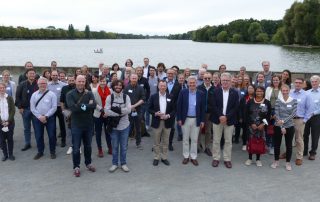
We are very pleased that our second symposium could take place as a joint RESIST / SFB900 symposium from 4 to 5 October 2021 at the hotel "Courtyard Hannover Maschsee". You can find the programme here. You will find a report on the symposium in this newsletter from page 4. More information about our research

2022-05-16T10:27:03+02:00 6. October 2021|

RESIST again receives one million euros

The Volkswagen Foundation and the state of Lower Saxony are supporting RESIST - as they did in February 2021 - with one million euros from the "Niedersächsisches Vorab". Four RESIST professors will use the funding for their research. Why do some premature babies die from infections? What roles do infections and intestinal bacteria in early childhood play in lifelong susceptibility to infection? Professor Dr. Sarina Ravens is investigating these questions at the MHH Institute of Immunology. The scientist is focusing on certain white blood cells of the immune system (B and T cells). She is also researching in another RESIST [...]

2022-05-12T11:04:43+02:00 29. September 2021|

Successful launch of HAGIS

Hannover and Glasgow plan to conduct more research together and to offer an excellent training environment: Scientists from the Cluster of Excellence RESIST and the MRC-University of Glasgow Centre for Virus Research (CVR)  have launched the Hannover-Glasgow Infection Strategy (HAGIS) project. They aim to use their complementary strengths to advance the development of new therapies for infectious diseases – for example, in the areas of viral infections in susceptible individuals and emerging viral infections – and PhD students will benefit from the combined research strengths of the two sites. The Lower Saxony Ministry of Science and Culture is funding [...]

2022-05-12T11:04:53+02:00 1. September 2021|

Study on SARS-CoV-2: Cross-vaccination protects effectively

Combination of vaccines from AstraZeneca and Biontech/Pfizer protects particularly well - even with virus variants The Standing Committee on Vaccination (STIKO) supports a second vaccination with an mRNA vaccine such as the one from Biontech/Pfizer for people under 60 who have already received an AstraZeneca vaccination – based on risk-benefit considerations. This recommendation is based on various research papers that were in preliminary stages of publication in scientific journals. Now the results of a study at the Hannover Medical School (MHH) by RESIST-Co-Speaker Professor Dr Reinhold Förster, head of the Institute of Immunology, and Professor Dr Georg Behrens, Clinic [...]

2022-05-12T11:05:01+02:00 15. July 2021|

New in our RESIST team: Professor Depledge

Professor Daniel P. Depledge, PhD, Professor of Systems Biology of Viruses within the German Centre for Infection Research (DZIF) since June 2021 is a new member of RESIST. "The opportunity to expand my research interests and engage in translational research led me to move from New York to Hannover to join the Institute of Virology at Hannover Medical School (MHH). Here I look forward to collaborating closely with many excellent virologists, RNA biologists and immunologists, while continuing to build new collaborations across Europe," says the 40-year-old. Professor Depledge investigates how herpesviruses survive and spread in people's bodies. To do [...]

2022-05-12T11:05:27+02:00 14. June 2021|

The third dose

How long does the vaccination protection against SARS-CoV-2 last? Are ongoing vaccinations necessary? Prof. Schulz tells us what is currently known about it: Professor Schulz, how long is one protected against SARS-CoV-2 after the double vaccination? This is not clear yet and can vary greatly between different individuals, as vaccinated people differ in the level of their immune response. Protection against SARS-CoV-2 will last longer in someone with a strong immune response to the vaccine than in someone with a weak response. On average, the protection of a vaccinated person this year should last into next year. Will a [...]

2022-05-12T11:05:36+02:00 9. June 2021|

Every single cell counts – even before birth!

Certain immune cells develop early in life and remain throughout life Some things are particularly deeply rooted: for example, certain white blood cells of the adult immune system are already formed around the eighth week of pregnancy. These are gamma-delta T cells, more precisely theVγ9Vδ2+ T cells. They can recognise bacterial infections as well as tissue damage and changes, such as cancer, or act as inflammation-enhancing cells in autoimmune diseases. They are found in the blood, but also in the intestine, skin, liver and lungs. Professor Dr. Sarina Ravens and Dr. Alina Fichtner from the Institute of Immunology at [...]

2022-05-12T11:05:43+02:00 26. May 2021|

RESIST team investigates antibiotic resistance

The impact of the COVID-19 pandemic on multidrug-resistant pathogens: How do the hygiene and distance rules introduced due to the pandemic influence the transmission of multidrug-resistant pathogens in hospitals? Professor Dr Marco Galardini and Professor Dr Susanne Häußler are investigating this question in a new three-year project. The DFG is supporting them with funding of 300,000 euros. "With this project we want to investigate which bacterial strains circulate in hospitals and with what frequency they occur there," explains Professor Galardini. To answer these questions, the research team will combine genetic and epidemiological data obtained through sequencing and digital tracking. [...]

2022-05-12T11:05:51+02:00 14. April 2021|

Fast & Reliable

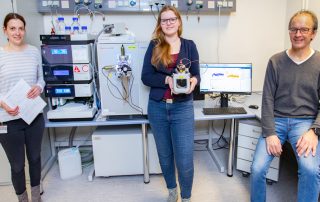
A new mass spectrometer – funded by RESIST and the MHH – speeds up research. "It's a real workhorse: fast and solid". This is how Professor Dr. Andreas Pich describes the new mass spectrometer of the MHH research facility Proteomics: "We can now investigate the cell protein processes much more quickly. This new device is the fifth mass spectrometer in the lab, it can analyse samples about three times as fast as older models and it ideally complements the lab's equipment," explains the Proteomics director. Another advantage: more measuring times are now available for the other mass spectrometers in [...]

2022-05-12T11:05:58+02:00 25. March 2021|
Go to Top