

How can a precise characterisation of microbial communities result in the development of new strategies against biofilm-associated infections?

What is this research project about?
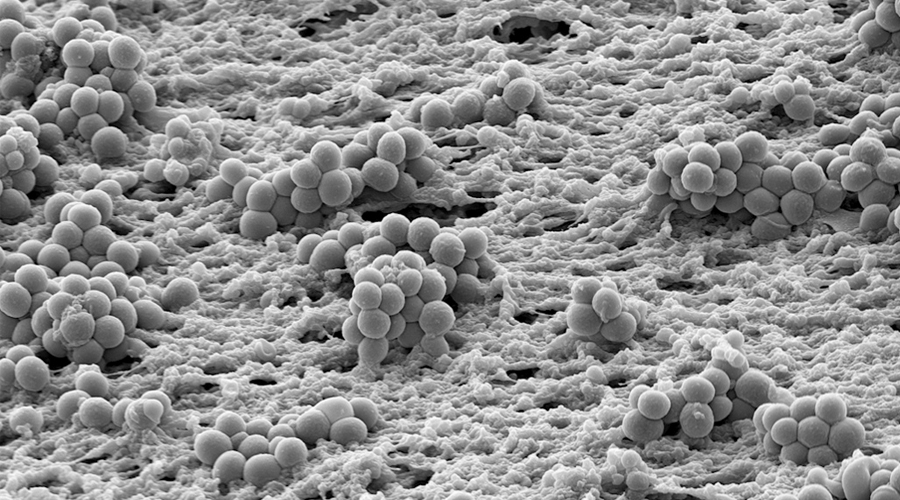
Biofilme: There is a lack of treatment options for infections associated with them.

What is this research project about?

Bacteria in biofilms are embedded in a self-produced extracellular matrix and exhibit an increased resistance to adverse conditions. In the human host, biofilm bacteria are responsible for persistent infections and efficiently withstand antibiotic treatment and the host immune response. Once a bacterial biofilm infection is established it becomes very difficult to eradicate, even in the absence of genotypic resistance. Biofilm infections affect millions of people and every year chronic infections in patients due to biofilm formation are a multi-billion Euro burden to national healthcare systems. With progress of medical sciences, more and more indwelling devices for the purpose of medical treatments and foreign body implants are applied. Infection continues to be a major complication of their use. Also, there are biofilm infections not associated with foreign bodies, such as chronic infections of the lungs of cystic fibrosis patients and of patients with chronic obstructive pulmonary diseases. Ongoing inflammation and changes in the structure and function of the affected tissue largely determine morbidity and mortality in these patients.

We want to identify biomarkers whose presence is correlated with the resistance of the Pseudomonas aeruginosa biofilm and genetic / metabolic patterns and which characterize the switch to the establishment of pathogenic biofilms on implants. This will serve to develop a diagnostic tool for biofilm resistance and disease excitation Profiling and innovative treatment strategies targeting biofilm resistance mechanisms.

What’s the current status?

Although chronic biofilm-associated infections have been extensively studied, there are many open questions and the general recalcitrance of biofilm-grown bacteria is only incompletely understood. The successful use of antibiotics to eradicate biofilm-associated infection relies on our ability to overcome several main problems. First, for a more targeted anti-biofilm therapy, knowledge on the biofilm-specific resistance profile of individual bacterial isolates is essential, as well as knowledge on when natural colonizing bacterial communities transition to pathogenic biofilms e.g. on implants. In addition, new therapy options will have to be developed to overcome the second limitation of current treatment, which is the general recalcitrance of biofilm populations.
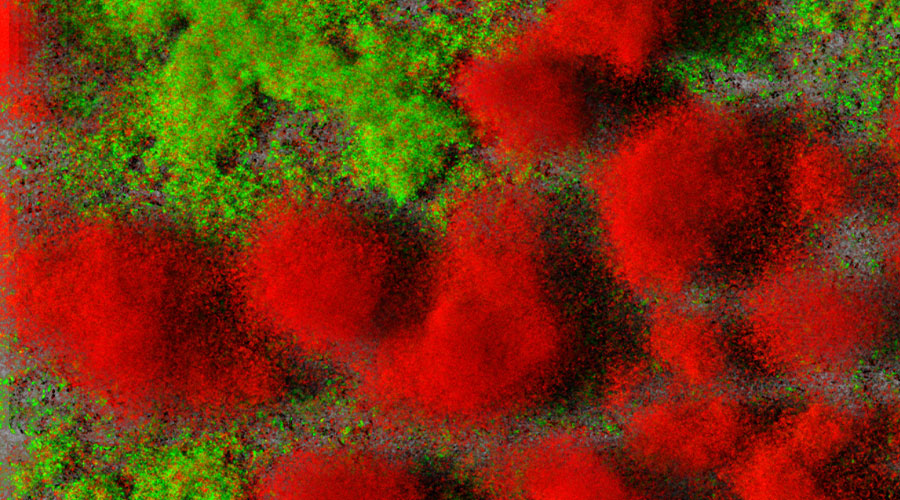
Biofilms of clinical idolates of Pseudomonas aeruginosa, living cells are green, dead cells are red. Source: TWINCORE / Jann Thöming

What are the project goals?

The combination of detailed information of the infecting pathogens with advanced phenotypic and genotypic profiling methodologies holds considerable promise for improving strategies to combat chronic biofilm-associated infections. Knowledge on etiological mechanisms underlying the evolution of biofilm resistance has the promise to change the way physicians treat chronic infections. This work is undertaken with the view to address a critical unmet medical need and to provide the necessary conditions to develop effective individualized diagnostic and therapeutic intervention strategies for the control of biofilm-associated infections.

How do we get there?

Our research groups have established extensive expertise in the analysis of the structure, assembly and microbiological diversity of medical biofilms, and have applied methodologies including DNA/RNA sequencing and machine learning approaches to describe the genomic and transcriptional landscape of infecting pathogens in vitro and ex vivo. Within RESIST we want to transfer gained knowledge and experience from our work on bacterial biofilms and establish a genome-based prediction of bacterial phenotypes by integrating complex OMICS-data also using machine learning classifiers, phylogenomic clustering and feature selection techniques.

Biofilms of clinical idolates of Pseudomonas aeruginosa, living cells are green, dead cells are red. Source: TWINCORE / Jann Thöming


Projectleaders

Project title: Biofilm profling

Prof. Dr. Susanne Häußler

Projects: C1, C2

Prof. Dr. Meike Stiesch

Projects: C1, C2

Project C1 Publications

Publications 2025

(p)ppGpp imposes graded transcriptional changes to impair motility and promote antibiotic tolerance in biofilms F. Engelhardt, K. Turnbull, M. Gür, M. Müsken, M. Preusse, S. Häussler, et al. NPJ Biofilms Microbiomes 2025 Vol. 11 Issue 1 Pages 148 Accession Number: 40750589 PMCID: PMC12316884 DOI: 10.1038/s41522-025-00795-7

The Submucosal Microbiome Correlates with Peri-implantitis Severity – PubMed A. A. Joshi, S. P. Szafrański, M. Steglich, I. Yang, W. Behrens, P. Schaefer-Dreyer, et al. J Dent Res 2025 Pages 220345251352809 Accession Number: 40719760 DOI: 10.1177/00220345251352809

Integrative microbiome- and metatranscriptome-based analyses reveal diagnostic biomarkers for peri-implantitis A. A. Joshi, S. P. Szafrański, M. Steglich, I. Yang, T. Qu, P. Schaefer-Dreyer, et al. NPJ Biofilms Microbiomes 2025 Vol. 11 Issue 1 Pages 175 Accession Number: 40858628 DOI: 10.1038/s41522-025-00807-6

Publications 2024

Tetramerization is essential for the enzymatic function of the Pseudomonas aeruginosa virulence factor UDP-glucose pyrophosphorylase. Dirr, L., S. Cleeves, I. Ramón Roth, L. Li, T. Fiebig, T. Ve, S. Häussler, A. Braun, M. von Itzstein, and J. I. Führing. 2024.  mBio 15: e0211423.

Structure and composition of early biofilms formed on dental implants are complex, diverse, subject-specific and dynamic S. Dieckow, S. P. Szafranski, J. Grischke, T. Qu, K. Doll-Nikutta, M. Steglich, et al. NPJ Biofilms Microbiomes 2024 Vol. 10 Issue 1 Pages 155 Accession Number: 39719447 PMCID: PMC11668855 DOI: 10.1038/s41522-024-00624-3

Publications 2022

Pseudomonas aeruginosa Is More Tolerant Under Biofilm Than Under Planktonic Growth Conditions: A Multi-Isolate Survey. Thöming JG, Häussler S.  Front Cell Infect Microbiol.

Transcriptional Profiling of Pseudomonas aeruginosa Infections. Thöming JG, Häussler S.  Adv Exp Med Biol. 2022;1386:303-323.

Evolution of biofilm-adapted gene expression profiles in lasR-deficient clinical Pseudomonas aeruginosa isolates.Jeske A, Arce-Rodriguez A, Thöming JG, Tomasch J, Häussler S.  NPJ Biofilms Microbiomes. 2022 Feb 14;8(1):6.

Rapid and accurate identification of ribosomal RNA sequences via deep learning.Deng ZL, Münch PC, Mreches R, McHardy AC. Nucleic Acids Res.

Dual Effect: High NADH Levels Contribute to Efflux-Mediated Antibiotic Resistance but Drive Lethality Mediated by Reactive Oxygen Species A. Arce-Rodríguez, D. Pankratz, M. Preusse, P. I. Nikel and S. HäusslermBio 2022 Vol. 13 Issue 1 Pages e0243421 DOI: 10.1128/mbio.02434-21

Pseudomonas aeruginosa post-translational responses to elevated c-di-GMP levels. Bense S, Witte J, Preuße M, Koska M, Pezoldt L, Dröge A, Hartmann O, Müsken M, Schulze J, Fiebig T, Bähre H, Felgner S, Pich A, Häussler S. Mol Microbiol.

Publications 2021

Analysis of the organization and expression patterns of the convergent Pseudomonas aeruginosa lasR/rsaL gene pair uncovers mutual influence S. Schinner, M. Preusse, C. Kesthely and S. Häussler Molecular Microbiology 2021 Vol. 115 Issue 4 Pages 643-657 DOI: 10.1111/mmi.14628

Evolution of Pseudomonas aeruginosa toward higher fitness under standard laboratory conditions. Grekov I, Thöming JG, Kordes A, Häussler S. ISME J.

Quo vadis clinical diagnostic microbiology? Haag S, Häussler S. Clin Microbiol Infect.

Removable denture is a risk indicator for peri-implantitis and facilitates expansion of specific periodontopathogens: a cross-sectional study. Grischke J, Szafrański SP, Muthukumarasamy U, Haeussler S, Stiesch M. BMC Oral Health.

Publications 2020

Parallel evolutionary paths to produce more than one Pseudomonas aeruginosa biofilm phenotype. Thöming JG, Tomasch J, Preusse M, Koska M, Grahl N, Pohl S, Willger SD, Kaever V, Müsken M, Häussler S. NPJ Biofilms Microbiomes.

Expression of the MexXY Aminoglycoside Efflux Pump and Presence of an Aminoglycoside-Modifying Enzyme in Clinical Pseudomonas aeruginosa Isolates Are Highly Correlated. Seupt A, Schniederjans M, Tomasch J, Häussler S.  Antimicrob Agents Chemother.

Genetic determinants of Pseudomonas aeruginosa fitness during biofilm growth. Schinner S, Engelhardt F, Preusse M, Thöming JG, Tomasch J, Häussler S. Biofilm.

Non-Invasive Luciferase Imaging of Type I Interferon Induction in a Transgenic Mouse Model of Biomaterial Associated Bacterial Infections: Microbial Specificity and Inter-Bacterial Species Interactions. Rahim MI, Winkel A, Lienenklaus S, Stumpp NS, Szafrański SP, Kommerein N, Willbold E, Reifenrath J, Mueller PP, Eisenburger M, Stiesch M.  Microorganisms. 2020 Oct 21;8(10):1624. doi: 10.3390/microorganisms8101624. PMID: 33096869; PMCID: PMC7589032.

Predicting antimicrobial resistance in Pseudomonas aeruginosa with machine learning-enabled molecular diagnostics. Khaledi A, Weimann A, Schniederjans M, Asgari E, Kuo TH, Oliver A, Cabot G, Kola A, Gastmeier P, Hogardt M, Jonas D, Mofrad MR, Bremges A, McHardy AC, Häussler S. EMBO Mol Med. 2020 Mar 6;12(3):e10264. doi: 10.15252/emmm.201910264. Epub 2020 Feb 12. PMID: 32048461; PMCID: PMC7059009.

Host-induced spermidine production in motile Pseudomonas aeruginosa triggers phagocytic uptake. Felgner S, Preusse M, Beutling U, Stahnke S, Pawar V, Rohde M, Brönstrup M, Stradal T, Häussler S. Elife.

Organism-specific depletion of highly abundant RNA species from bacterial total RNA. Engelhardt F, Tomasch J, Häussler S.  Access Microbiol. 

Targeting bioenergetics is key to counteracting the drug-tolerant state of biofilm-grown bacteria. Donnert M, Elsheikh S, Arce-Rodriguez A, Pawar V, Braubach P, Jonigk D, Haverich A, Weiss S, Müsken M, Häussler S.PLoS Pathog.

Biofilm formation on zirconia and titanium over time-An in vivo model study. Desch A, Freifrau von Maltzahn N, Stumpp N, Dalton M, Yang I, Stiesch M.  Clin Oral Implants Res. 2020 Sep;31(9):865-880. doi: 10.1111/clr.13632. Epub 2020 Jul 9. PMID: 32583509.

Publications 2019

Diversity patterns of bacteriophages infecting Aggregatibacter and Haemophilus species across clades and niches. Szafrański SP, Kilian M, Yang I, Bei der Wieden G, Winkel A, Hegermann J, Stiesch M.  ISME J.

Publications of the Project C1