


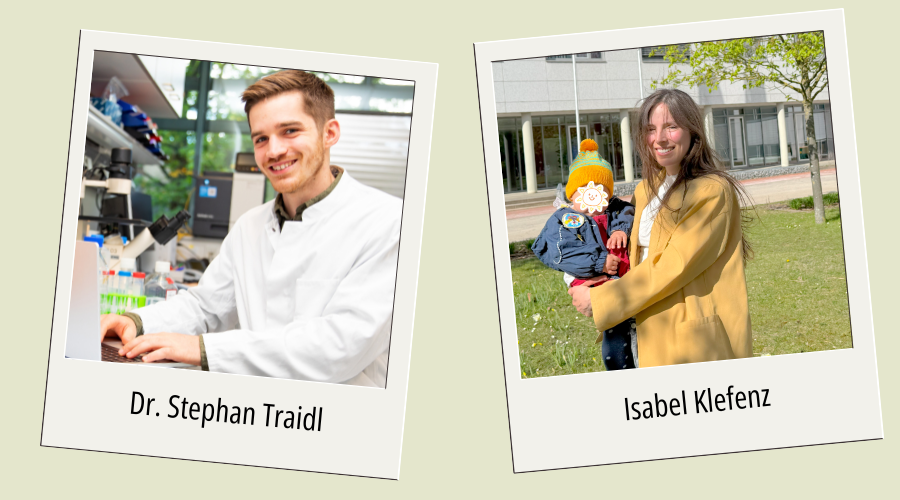
The RESIST Cluster of Excellence has elected two new representatives for the YOUNG RESIST committee: PD Dr. Stephan Traidl will take on the role of postdoc representative, while Isabel Klefenz will represent the interests of doctoral students. Both bring not only solid scientific expertise but also a strong commitment to networking and interdisciplinary collaboration.
Stephan Traidl studied medicine at Hannover Medical School (MHH) and received support during his studies through several scholarships, including the German National Academic Foundation and the Hannover Biomedical Research School (HBRS). International stays in Switzerland, the United Kingdom, and the United States, particularly in the fields of dermatology and allergology, shaped his scientific interests early on.
His doctoral thesis, completed as part of the HBRS’s StrucMed program, focused on eczema herpeticatum in atopic dermatitis. He has been working at the Department of Dermatology, Allergology, and Venereology at MHH since 2019. Subsequently, he completed the DFG-funded Clinician-Scientist Program “PRACTIS” and, parallel to his specialist training, the Master’s program in Biomedical Data Science established within the framework of RESIST. Since 2025, he has been habilitated and a board-certified specialist, and is additionally pursuing a PhD in Data Science. His research focuses on herpes infections in atopic dermatitis, as well as the SI and VZV cohorts within the context of the RESIST Cluster of Excellence.
As a scientist long associated with RESIST, Traidl is particularly interested in strengthening the link between clinical practice and research. A central concern for him is the promotion of early-career researchers: “Modern research is highly specialized and thrives on collaboration. YOUNG RESIST can play a decisive role here—both in networking young researchers and in building bridges to established scientists.” She also places particular importance on the further development of transparent and fair funding models for early-career projects and conference travel.
Isabel Klefenz also brings an international and interdisciplinary background to the role. After a study abroad program at the University of Nice Sophia-Antipolis in France, she began her medical studies at Philipps University of Marburg in 2015, focusing on infectious diseases and immunology from the outset. At the same time, she studied chemistry for a period and spent two semesters at Heriot-Watt University in Edinburgh as part of an ERASMUS exchange. After graduating in 2022, she began the HBRS MD/PhD program in “Molecular Medicine” at the Institute of Human Genetics. There, under the supervision of Prof. Dr. rer. nat. Doris Steinemann, she is conducting research on the detection of structural genome variants in patients with immunodeficiency, primarily antibody deficiency syndromes, using optical genome mapping in particular. Her project is part of a research initiative funded by RESIST.
In her new role, Klefenz sees above all an opportunity to further strengthen collaboration within RESIST: “Exchange between research groups opens up new perspectives and enables deeper insights than isolated projects.” She would like to focus in particular on supporting young scientists, intensifying the exchange of ideas, and improving communication within the network. At the same time, she looks forward to gaining new inspiration from the work of other groups.
With Stephan Traidl and Isabel Klefenz, YOUNG RESIST gains two dedicated representatives who are committed to strong networking, transparent funding, and close collaboration across disciplinary boundaries. In doing so, they are helping to actively shape the future of the Cluster of Excellence.
Copyright Foto Traidl: Karin Kaiser/MHH
Copyright Foto Klefenz: Marina Vnuchko/RESIST