


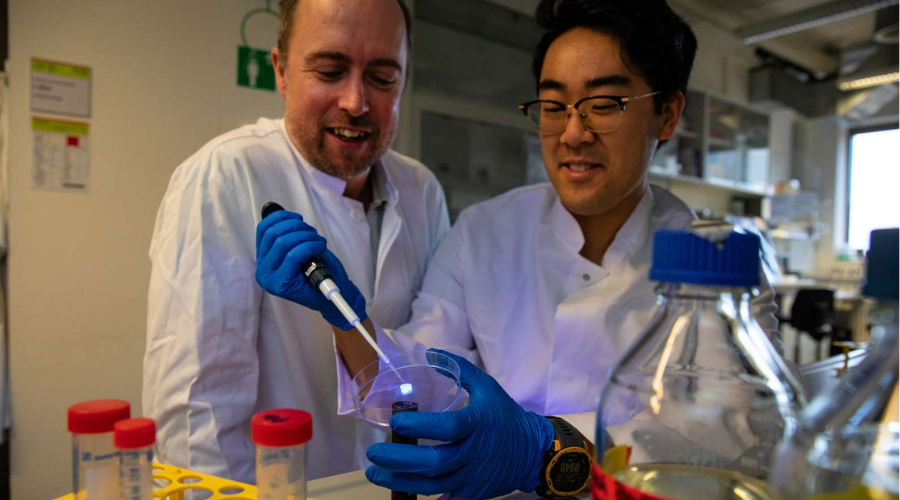
At MHH, a Fulbright scholar is combining engineering and immunology to improve wound treatment.
Chronic wounds often cause great distress to those affected, as they heal very poorly, are painful, and restrict movement. At Hannover Medical School (MHH), Fulbright scholar Samuel Sung from the USA is now spending a year researching new therapeutic approaches to improve the healing of chronic wounds in collaboration with the team of Prof. Dr. Nico Lachmann, who is part of the RESIST research group. To this end, he is combining engineering with immunology and focusing on the use of specialized immune cells.
Macrophages (scavenger cells) play a central role in wound healing. These immune cells coordinate inflammation, remove deposits, and provide new tissue. If these processes do not function properly, wound healing can no longer take place correctly, promoting chronic wounds. Professor Lachmann’s team at the Department of Pediatric Pneumology, Allergology, and Neonatology at MHH can specialize macrophages and produce them from human induced pluripotent stem cells (iPS cells), which could serve as replacements in the future.
The goal is the next generation of wound healing therapies
However, it is still unclear how these cells can be specifically introduced into the wound. Which compresses and gels are suitable for this purpose? To answer these questions, Samuel Sung uses artificially produced hydrogels that serve as carrier material and have been loaded with specialized macrophages. He is investigating how the gels influence the behavior of the phagocytes and thus the immune response, and whether they can promote skin regeneration efficiently and in a controlled manner. “We want to work together to develop the next generation of wound healing therapies,” says Professor Lachmann.
Samuel Sung has also worked with macrophages in his previous work in Professor Kara Spiller’s laboratory at Drexel University in Philadelphia, and now he can link his studies with human immune cells. “His arrival strengthens our growing partnership with Professor Spiller’s laboratory, which is internationally recognized for its expertise in biomaterials and immune engineering,” emphasizes Professor Lachmann. Immune engineering combines engineering techniques with immunological research to develop innovative therapeutic approaches – not only for chronic wounds, but also for organ regeneration and infection research.
Photo: Samuel Sung (right) holds a dish containing gel in Prof. Dr. Nico Lachmann’s (left) laboratory. He demonstrates how he adds phagocytes, which are intended to assist in wound healing.